
Inside Death Row: The Unprecedented Protocol Failures and Firing Squad Mandates Upending America’s Capital Chambers

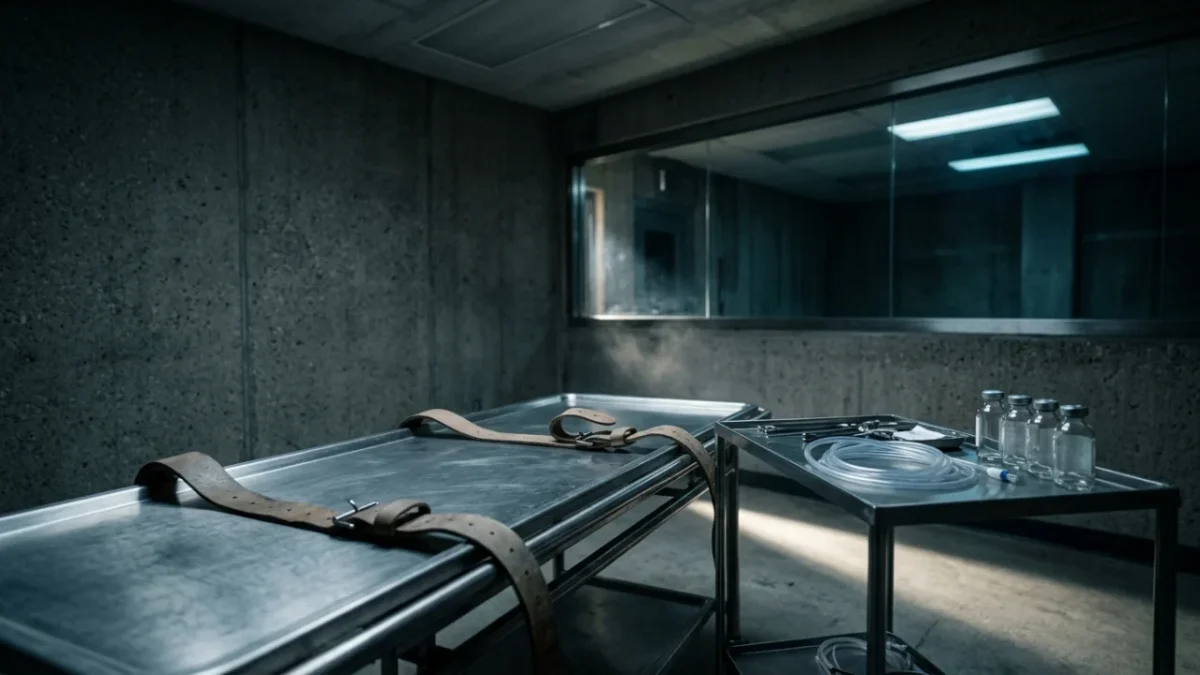 Death Row
High-security perimeter fencing and watchtowers define death row units across state and federal facilities.
When an execution team steps inside a death chamber, correctional protocol demands absolute mechanical precision, yet the American capital punishment system is confronting operational crises unseen in modern penal history. In Tennessee, condemned inmate Christa Pike survived two full doses of pentobarbital and regained consciousness, making her the only recorded person in modern history to wake up after chemical administration. Simultaneously, the Pentagon has scheduled a televised firing squad execution for Fort Hood shooter Nidal Hasan, shattering six decades of military precedent and exposing raw fractures across state and federal Death Row management.
For officers who have walked death row tiers, the reality behind heavy steel sliders bears little resemblance to Hollywood drama. Days are governed by rigid tier-check intervals, constant mental health logs, and the quiet tension of condemned men and women awaiting judicial warrants. When lethal injections fail or tactical execution squads are mobilized, the entire institutional security posture shifts from routine isolation to severe constitutional crisis.
The operational breakdown inside Riverbend Maximum Security Institution during the September 30 warrant for Pike has left prison leadership scrambling for answers. Pike, condemned for the 1995 murder of 19-year-old Colleen Slemmer, was wheeled out of the chamber alive after technicians delivered the lethal compound. Now ambulatory but medically disoriented, her case pushes state corrections into uncharted legal and ethical territory.
In maximum security management, the quietest unit is usually the one under the tightest internal discipline, but an interrupted execution permanently breaks institutional protocol.
The Anatomy of Chamber Failures: From Broken Lines to Chemical Breakdown
Execution teams are composed of designated correctional personnel and contracted technicians working behind shielded observation glass. State protocols dictate establishing primary and secondary intravenous lines, followed by chemical flushes designed to confirm patent venous access before lethal toxins flow. When veins blow or peripheral access collapses under stress, the death chamber instantly transforms into an emergency medical triage floor.
Pike represents the eighth documented instance in recent decades where executioners failed to terminate life using their intended method. Unlike previous botched procedures where staff could not insert needles, Tennessee officials actually administered the pentobarbital into Pike’s bloodstream before the procedure halted. Outgoing Republican Governor Bill Lee has halted further action pending an independent review into what collapsed inside Riverbend’s death house.
Tennessee had already suffered a high-profile logistical breakdown just four months earlier in May, when prison officials aborted the execution of death row inmate Tony Carruthers. During that attempt, personnel spent over an hour attempting to find a secondary backup vein and failed at central line insertion before calling off the warrant. Carruthers remains housed on death row under a mandatory one-year operational pause.
Documented Chamber Abortions and Inmate Dispositions
The historical record shows that when a capital procedure fails, the correctional system rarely possesses an immediate playbook for the surviving prisoner:
- Romell Broom (Ohio, 2009): Technicians administered 18 needle sticks over two hours without establishing an intravenous line; Broom returned to general death row confinement and died in 2020 from natural causes and COVID-19 complications.
- Alva Campbell (Ohio, 2017): Execution aborted after executioners failed to locate usable veins; Campbell died of natural causes in his death row cell four months later.
- Doyle Lee Hamm (Alabama, 2018): Halted after punctured extremities caused severe physical trauma; Hamm died in custody in 2021 without facing a second warrant.
- Alan Eugene Miller (Alabama, 2022): Re-executed successfully via nitrogen hypoxia in September 2024 after an initial injection attempt left him strapped to a gurney for over an hour.
- Kenneth Eugene Smith (Alabama, 2022): Survived when his midnight warrant expired during failed line insertions, later becoming the nation’s first inmate executed by nitrogen gas in January 2024.
- Thomas Eugene Creech (Idaho, 2024): Halted after eight needle punctures across his arms, legs, and feet forced the warden to abort; Creech remains incarcerated under capital status.
The Military Shift: Firing Squads and Livestream Mandates
While state departments of corrections struggle to secure lethal pharmaceuticals and certified vascular access teams, the federal military justice apparatus is pivoting toward physical ballistic force. Defense Secretary Pete Hegseth confirmed that former Army psychiatrist Nidal Hasan is scheduled to face a firing squad on December 3 at the Fort Hood installation in Texas. Hasan was convicted of killing 13 people and wounding 32 others during the November 2009 mass shooting.
The Pentagon’s announcement that the military execution will be publicly livestreamed marks an unprecedented escalation in federal capital execution strategy. The United Nations Office of the High Commissioner for Human Rights immediately issued a formal condemnation, declaring that broadcasting an inmate’s death constitutes public execution and breaches international treaties barring torture. Military legal specialists note that Hasan’s defense council can still petition federal civilian courts via habeas corpus, an appeal that could freeze the military warrant indefinitely.
| Inmate / Jurisdiction | Documented Chamber Outcome |
|---|---|
| Christa Pike (Tennessee) | Survived two lethal doses of pentobarbital; returned to custody conscious and speaking under state administrative review. |
| Nidal Hasan (U.S. Military) | Scheduled for December 3 execution by firing squad at Fort Hood with military livestreaming directives. |
| Tony Carruthers (Tennessee) | Procedure halted in May after IV line insertion failure; secured minimum one-year execution pause. |
| Thomas Eugene Creech (Idaho) | Halted after eight failed vein punctures across extremities; currently confined on state capital tier. |
| Kenneth Eugene Smith (Alabama) | Survived 2022 lethal injection failure; executed via nitrogen gas protocol in January 2024. |
Operational Realities on the Segregation Tiers
On maximum-security tiers housing condemned inmates, life is dictated by non-negotiable security directives. Inmates are subject to solitary confinement for up to 23 hours a day, manual strip searches before every tier escort, and full iron restraints whenever they step outside their cells. The administrative reality of keeping an individual alive for decades while preparing for their state-ordered death creates a unique strain on correctional officers tasked with professional detachment.
When an execution fails, that internal balance shatters. Returning an inmate from the execution gurney back to an administrative segregation cell requires round-the-clock suicide watch, medical charting, and heightened tactical security to prevent staff hostage scenarios or inmate self-harm. For correctional officers walking those tiers, the policy battles fought in appellate courts and executive mansions carry real physical consequences inside the housing units.
⚖️ Capital punishment in the United States has reached a critical junction where pharmaceutical access, technical competency, and constitutional standards are clashing inside the death house.
🚨 As federal courts review the legality of firing squads and livestream mandates, state prison systems must account for how botched procedures dismantle public trust and officer safety.
📁 The survival of condemned prisoners like Pike forces lawmakers to confront whether multiple execution attempts cross the threshold of cruel and unusual punishment under the Eighth Amendment.
🔒 True justice demands procedural absolute certainty, but behind the concrete walls of America’s maximum-security prisons, that certainty is fracturing with every aborted warrant.
What is your take on the return of firing squads and the future of death row procedures? Share your perspective in the comments below.







